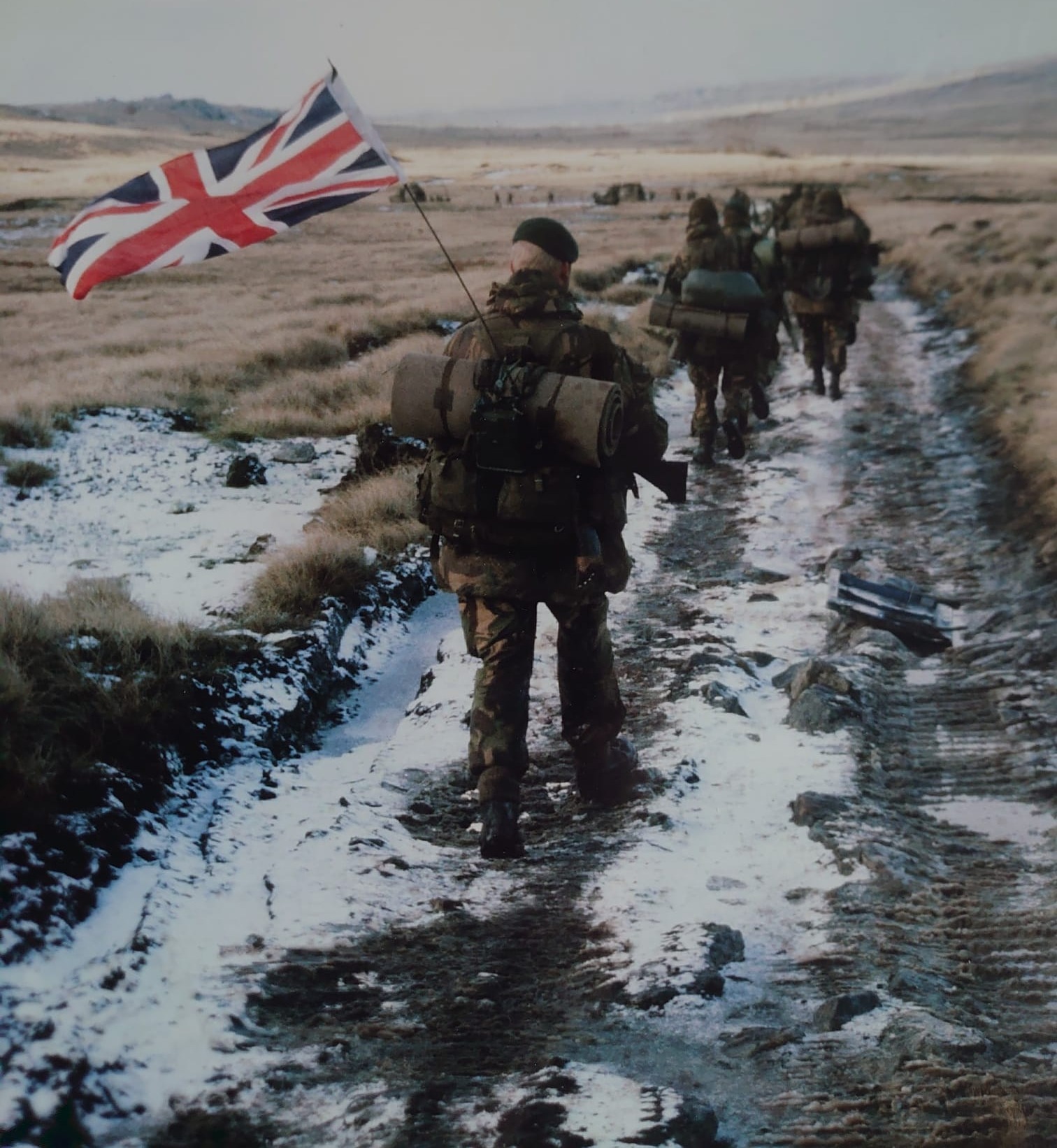
This is the most famous image of the Falklands War - six Royal Marines jumping with the Union Jack flying proudly from their radio antenna.
However, aside from flag bearer Pete Robinson, the other Marines have never been publicly identified—until now.
6
This week The Sun brought six of them together in Dartmoor, Devon, where they met again for the first time in 40 years.
We also reunited the heroes with paratrooper photographer Pete Holdgate, who took the iconic photo on June 14, 1982, the day Argentina surrendered.
Pete, now 71, has recreated his famous “yomper” photograph, which has come to symbolize Britain’s incredible battle to reclaim tiny islands in the South Atlantic 8,000 miles from the UK.
Four decades ago, they were healthy young Royal Marines who were forced to race - slang for march march - almost 80 miles across icy terrain to help defeat a 10,000-strong Argentine occupation force.
Today, as they meet for the first time since the photo was taken, the years are melting away.
After a series of grueling bear hugs and jokes, each man proudly dons his green beret.
They grab their Bergen packs - mercifully light compared to the 10 packs they weighed then - and drop into the formation they were pictured in 40 years ago.
Flying the flag is Corporal Pete Robinson, 63, of Swindon, and in front of him, meandering into the distance, are Marines Will Evans, 60, of Tamworth, Headquarters, Alec Watt, 58, of Plymouth, Ray Houghton, John “Tuff.” Davis and Colin Adams.
Most Read in The Scottish Sun
Colin, 58, from Kew, West London, says: “None of us knew how iconic this shot would be, so doing it again was a great opportunity.”
Photographer Pete says: “We haven’t seen each other since the Falklands War. A big thank you to The Sun for bringing us all together from the four corners of the country.”
The flag in our 2022 photo is slightly larger than the 1982 flag because no one knows where the original went. Fans hope that the Sun reader will be able to solve the mystery.
Will Evans found the original flag on the cruise ship SS Canberra en route to the conflict and it was used to transport British troops to the islands.
Colin Adams had just celebrated his 18th birthday when Argentina invaded the Falklands on 2 April. By May 21, Colin was on a landing craft heading in pitch darkness towards Blue Beach with his fellow 40 commandos.
He recalls: “Being the youngest in the detachment, I was pushed to the front. Obviously it’s a military tradition that the juniors have the honor of being first.
Yomper reunited
Heroes of Britain (LR)
Marine John “Tuff” Davis: The Welshman left the Marines in 1992 after a 20-year career. Since then, he has been working as a civil servant.
Marine Colin Adams: Veteran ULSTER Colin was selected for SBS but was discharged for health reasons in 1999. Suffering from PTSD, he worked as a diving instructor in Australia and met Argentine veterans in 2019. He is now married to Sally.
Marine Alec Watt: Since then, ALEC has worked in retail fraud and seaweed farming. He is married to Amanda, 54, has a son, Theo, 9, and is stepfather to Miles, 23, and Lucy, 26.
Petty Officer Pete Holdgate: Commando photographer Pete Holdgate later became a photo editor for the local newspaper.
Marin Ray Houghton: Veteran of Northern Ireland, Belize and Cyprus retired from the Marine Corps in 1990. He and his wife Serena have two children - nurse Nikki, 33, and police officer Carl, 31.
Corporal Pete Robinson: After the Falklands conflict, Corporal Pete Robinson met with Prime Minister Margaret Thatcher. His bronze statue, named Yomper, stands outside the Royal Marines Museum in Portsmouth. He now works as a stud farm manager for a charity for Arabian horses.
Marine Will Evans: The father of three put up the worn out soles of the boots he wore on his epic trip to the Falklands. After leaving the Marines in 1984, Will worked as a truck driver before switching to advertising. He became a geophysical driller.
“Caught in a minefield”
“I rushed forward and forward, right up to my chest in icy water.
“I got to the beach in half the time and took cover.
“A few hours after dawn, the first air raid hit us. Days of utter chaos followed as wave after wave of Argentine aircraft overwhelmed us. I saw so many downed planes, but they kept getting closer.”
Four days after landing, one of these attacks sank an RFA Atlantic Conveyor carrying Chinook helicopters to transport Marines across East Falkland. So instead, they had to jump.
Together with 45 commandos, they became part of a plan to capture three high points around Stanley’s capital - Mount Longden, Mount Harriet and Two Sisters.
From San Carlos they were sent to Teal Inlet, where an Argentine attack destroyed 45 commando anti-tank rocket launchers.
Yomp
What does Yomp mean?
The origin is unclear. Marine Corps slang means marching long distances in full gear.
Possibly an abbreviation for your pace of march.
Ray Houghton, 58, from South Shields, Tyne and Wear, says: “At first light, the order came to move on to Sapper Hill. On the way we heard about the white flags at Stanley.
“We were in the middle of a minefield when it was confirmed, so we didn’t celebrate much.
“We took care of our weapons and someone pulled out a flag to tie it to Pete’s radio mast.”
But Will’s flag, which was attached with black duct tape, was later blown away.
Pete says, “Will ran to get it and got a reprimand because he went into a minefield.”
As the six Marines made their way to Port Stanley, Chief Petty Officer Pete Holdgate spotted them.
Pete, who later became a photo editor for a local newspaper, recalls: “There were mines everywhere and people were stepping on each other’s tracks to stay safe.
“I followed him for almost two hours until the wind unfurled the flag and shot. I never expected him to get such a response.”
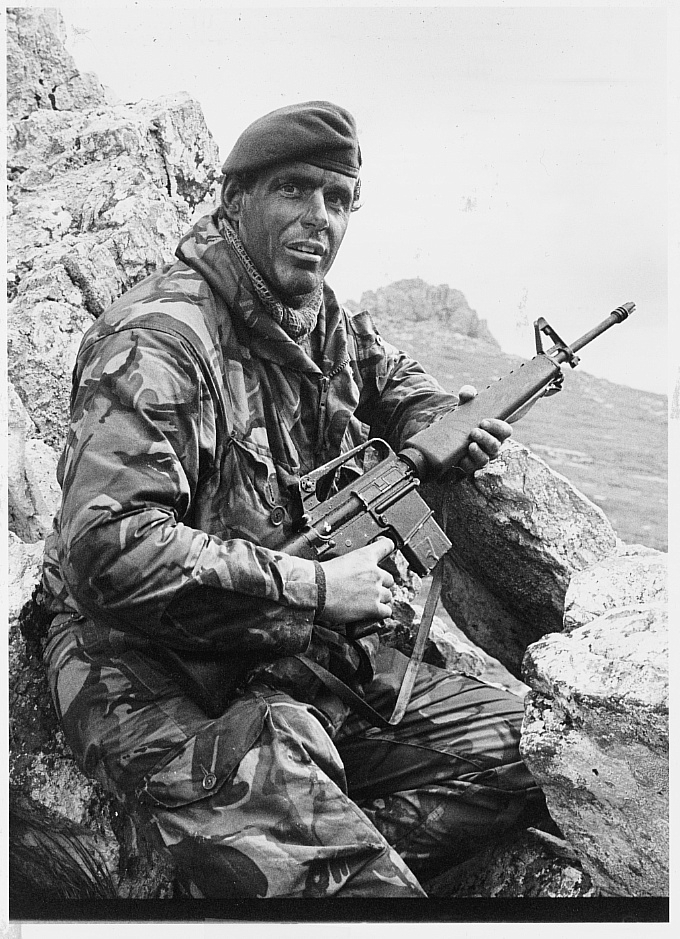
A photograph of John Davis, 62, hangs on the wall of his home in Evesham, Works, next to his green beret.
He says: “When we signed up, we knew we were going to face dangers. We are not heroes, we are lucky. Heroes are those who didn’t come home.”
6